Sustainability at Elia
As an electricity company that comprises two system operators, sustainability is rooted in the very nature of the Elia group’s activities. The integration of RES into the system and expansion of our grid means we are helping to drive the decarbonisation and electrification of society as a whole. Our ActNow programme furthers this, explicitly embedding sustainability into our strategy and business activities.
Discover our ActNow objectives
Published in 2021, ActNow comprises long-term targets for our organisation that are guided by the UN Sustainable Development Goals. ActNow is made up of five dimensions.




No results found
-
13 June 2024
Elia wins Blue Innovation Swell Award
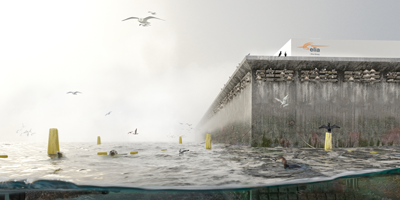
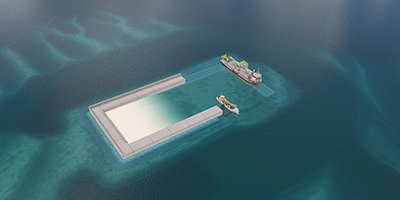
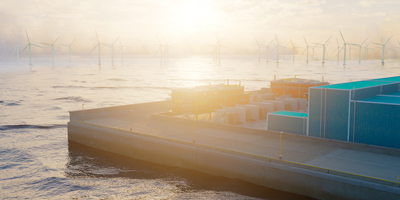
The Princess Elisabeth Island's nature inclusive design has won a Blue Innovation Swell Award. The judges of the Blue Innovation Awards praised the unique co-creation approach that Elia adopted: this involved bringing together experts in nature conservation and the marine environment from public and private institutions, universities, design consultancies and non-governmental organisations. -
10 January 2024
Elia Transmission Belgium successfully places second €800 million Green Bond
Elia Transmission Belgium (“ETB”) has successfully placed a €800 million green bond under its €6 billion Euro Medium Term Notes (“EMTN”) programme, to be listed on the Euro MTF market operated by the Luxembourg Stock Exchange. -
13 November 2023
Elia takes seven tangible measures to enhance biodiversity around the Princess Elisabeth Island
System operator Elia wants to boost biodiversity around the future energy island in the North Sea. -
03 October 2023
Environmental permit awarded for Princess Elisabeth Island, a key link in our future energy supply
Construction of the Belgian energy island will start early next year. North Sea Minister Vincent Van Quickenborne has approved the relevant environmental permit. -
15 June 2023
Elia and Ecofirst share their experience in managing ecological corridors under high-voltage lines
On 14 and 15 June, electricity transmission system operator (TSO) Elia took part in a workshop organised by the European NGO RGI (Renewables Grid Initiative) on the development of ecological corridors under high-voltage lines. -
15 February 2023
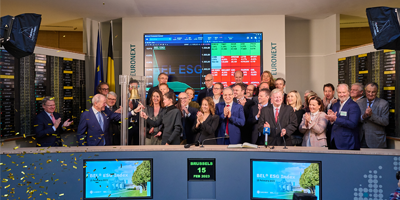
Elia Group is one of 20 companies to join the new BEL®ESG stock market index
Elia Group is one of the Belgian companies selected to be part of BEL®ESG, the new stock market index directly linked to sustainability launched today by Euronext. -
12 January 2023
Elia Transmission Belgium has successfully placed its inaugural €500 million Green Bond
Elia Transmission Belgium has successfully placed a €500 million Green Bond under its €3 billion Euro Medium Term Notes (“EMTN”) programme to be listed on the Euro MTF of the Luxembourg Stock Exchange. -
03 October 2022
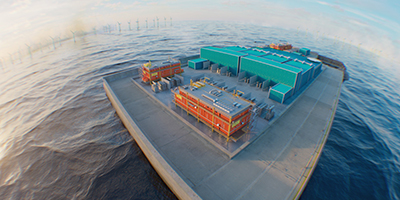
Elia presents its plans for an energy island, which will be called the Princess Elisabeth Island
In the presence of federal ministers Tinne Van der Straeten (Energy) and Vincent Van Quickenborne (North Sea), system operator Elia has presented its draft plans for what will be the world’s first artificial energy island. -
27 September 2022
A first in Belgium: Elia deploys drones to install bird diverters on its high-voltage lines
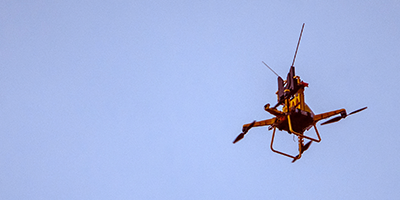
Today, Elia is installing bird diverters using drones – a first in Belgium. -
22 February 2022
Elia Group expands its international offshore activities through its new subsidiary WindGrid
Elia Group's Board of Directors has approved the formation of a new subsidiary. Through WindGrid, Elia Group is ready to meet offshore development needs. -
11 February 2022
Elia Group’s sixth Open Innovation Challenge is focused on sustainability
The annual Open Innovation Challenge (OIC) allows Elia Group to maintain close ties with a broad ecosystem of start-ups and small and medium-sized enterprises (SMEs). -
22 December 2021
Elia Transmission Belgium publishes its first Green Finance Framework, aligning its funding strategy with its objective to accelerate the energy transition
In line with Elia Group’s role as an enabler of the energy transition, Elia Transmission Belgium (ETB) - Elia Group’s Belgian subsidiary - has published its first ever Green Finance Framework. -
17 December 2021
Installation of markers on high-voltage lines leads to 75% fewer bird collisions
Installing markers on high-voltage lines leads to a sharp drop in the number of bird collisions, according to a Natuurpunt study commissioned by Elia. -
25 November 2021
ALEGrO, the first interconnector between Belgium and Germany, celebrates its first anniversary and a year of good results
The first electricity interconnector between Belgium and Germany was commissioned a year ago (on 18 November 2020) by system operators Elia and Amprion. ALEGrO posted good results for its first year of operation: 93 % of availability and exchanges totalling 4.5 TWh. -
23 November 2021
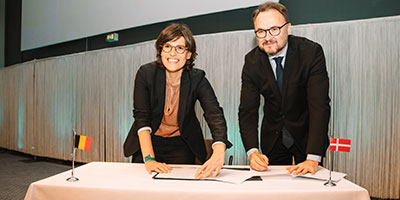
Elia and Energinet’s collaboration is advanced following preliminary study on hybrid interconnector between Belgium and Denmark
System operators Elia (Belgium) and Energinet (Denmark) are to continue collaborating on the implementation of what could become a world first: the first undersea connection between two artificial energy islands which will be able to exchange power between the two countries and at the same time transport electricity from offshore wind farms to the mainland. -
19 November 2021
Elia Group publishes “Roadmap to Net Zero”, our vision on building a climate-neutral European energy system by 2050
Tremendous efforts from across society are required to fight global warming. And yet, uncertainty remains about the necessary policies and the roadmap that can lead us to net zero. -
03 November 2021
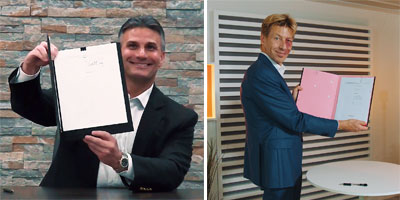
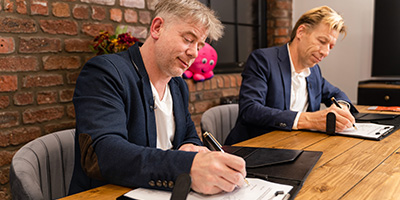
Elia Group (BE-GE) and Octopus Energy Group (UK) sign agreement to collaborate on consumer-centric energy flexibility services to facilitate the energy transition
Elia Group and Octopus Energy Group, two pioneering companies in the energy sector, have signed an MoU which reinforces their joint commitment to placing consumers at the heart of the energy transition. -
18 October 2021
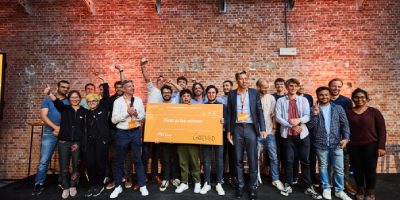
Green Bid wins Elia Group’s first ever hackathon on energy services for consumers with solution that allows prosumers to sell their excess solar energy
BRUSSELS -From 13 to 15 October, Elia Group hosted its first ever hackathon, which aimed to translate the Group’s vision on consumer centricity into tangible, practical solutions. -
22 September 2021
Elia makes overhead line by Eau d’Heure lakes more visible to birds
Bird markers help birds see the overhead line better so they don't collide with it. Elia, the operator of the Belgian high-voltage transmission grid, installed bird markers following a study that identified those lines in Belgium that are potentially the most dangerous to birds. -
30 August 2021
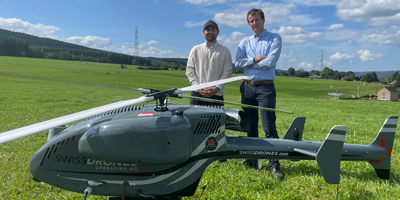
Elia Group tests long-range drones for inspecting power lines
A drone helicopter has been used for the first time for long-range inspections of power lines near Trois-Ponts. These BVLOS (beyond visual line of sight) drones may ultimately replace inspections using helicopters. -
12 July 2021
8 leading European transmission system operators launch a common initiative to support the energy system to reach carbon neutrality
They have published a joint paper that highlights the key enabling role TSOs are playing in the establishment of a climate-neutral society by 2050. -
04 June 2021
Elia Group presents its sustainability action plan: ACT NOW
In recent years, sustainability has become a core part of Elia Group's strategy. Our ACT NOW plan defines concrete and measurable objectives which outline how we will embed sustainability into our business processes in the years ahead. -
14 May 2021
Thirty companies selected for second round of tests in IO.Energy ecosystem to work on new energy services
Some 30 companies from various industries will test out new energy services as part of the Internet of Energy (IO.Energy). -
01 April 2021
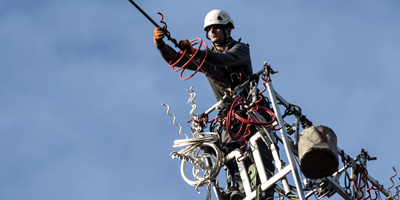
Elia makes overhead line in Ghent Canal Zone visible to birds
Bird markers have been installed on the overhead line by the R4 road in Evergem to ensure birds can see it better and collide with it less often. -
30 January 2021
Elia upgrades north-south axis of Belgian high-voltage grid between Kruibeke and Dilbeek
Elia, the Belgian high-voltage grid operator, is upgrading the north-south axis of the Belgian electricity grid
between the Mercator and Bruegel high-voltage stations in Kruibeke and Dilbeek, respectively. -
26 January 2021
Be Planet and Elia join forces to support sustainable development in eastern Liège Province
Following on from last June's call for projects from private individuals and associations, the Be Planet foundation and Elia today presented the 13 projects that will benefit from the community support fund in connection with the second phase of the East Loop (‘Boucle de l’Est’) project. -
14 January 2021
Elia Group’s fifth Open Innovation Challenge focuses on innovative solutions for offshore wind applications
Elia Group, a European Group of transmission system operators active in Belgium (Elia) and northeast Germany (50Hertz), is set to launch its fifth Open Innovation Challenge. -
09 October 2020
IO.Energy ecosystem enters its second phase and plans to test new energy services
The first sandboxing phase of the Internet of Energy (IO.Energy) project came to an end on Friday 9 October and was marked by an event attended by Thomas Dermine, the new State Secretary for Scientific Policy, Recovery and Strategic Investments. -
03 July 2020
Five Elia Group innovation competition finalists announced
Five finalists from different parts of the world are still in the running for the fourth Open Innovation Challenge. The contest is a joint initiative by Belgian system operator Elia and its German sister company 50Hertz. The Open Innovation Challenge helps Elia Group to innovate in highly specific areas of its work as a system operator by engaging in joint projects with start-ups. -
29 May 2020
Last offshore wind farm successfully connected to North Sea power hub
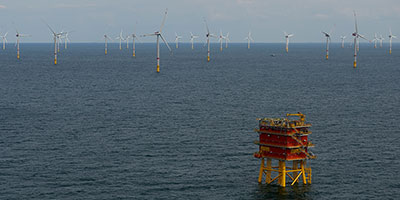
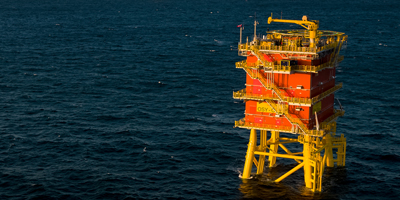
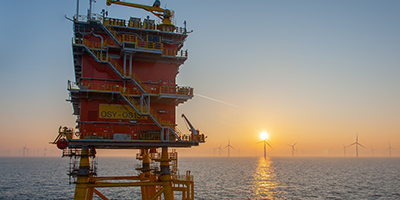
The connection of the Seastar wind farm marks the completion of the Modular Offshore Grid (MOG), Elia’s offshore power hub. Located 40 km off the Belgian coast, the switching platform bundles together the export cables from four offshore wind farms and transports the generated energy to the mainland via a shared transmission system



-
How is the ActNow change management process being felt across our workplaces a year after its introduction?Catherine Vandenborre: Greening our activities has become an integral part of our decision-making process. Many concrete actions related to this area have been identified. Our employees are eager to implement them and their execution is being closely monitored. To make our substations more sustainable, we have (for example) introduced new building standards. Roofs will be equipped with solar panels that power the heating and cooling facilities via smart temperature control. Along with other European system operators, we are putting pressure on our suppliers to make their processes more sustainable as well. Circularity is becoming increasingly important. There is also much greater awareness about diversity. It has become an important consideration for us in terms of recruitment.
-
Most of ActNow is dedicated to ‘Climate Action’, which is the first and most important dimension of the programme. What further work will be undertaken in this area?Catherine Vandenborre: Our business strategy anticipates social trends such as the growth in renewables, decentralisation, European integration and digitalisation. Therefore, the group will focus on three areas. Firstly, we need to accelerate the development of our grid infrastructure. Secondly, we are developing a new market design and new solutions for system control to integrate increasing volumes of renewables into the system. Finally, we are supporting society and industry as it addresses its immediate need to decarbonise and electrify its processes.
-
Industry is moving towards reaching carbon neutrality, but what about the group’s own carbon footprint?Catherine Vandenborre: As part of this, we are working on three different areas: reaching carbon neutrality in our system operations; reaching carbon neutrality in our own activities; and moving towards a carbon-neutral value chain. Our biggest carbon footprint comes from our grid losses. These are an inevitable part of power transmission and depend on factors such as the distance electricity has to be transported across, its current and voltage. It is our goal to reduce the CO2 footprint of our grid losses by 28% by 2030.
-
All the projects that we have discussed so far are about climate change mitigation; have you been addressing climate change adaptation?Catherine Vandenborre: In 2021, the worst floods Belgium had seen in decades hit the Walloon region. During the flooding, some of our infrastructure was damaged. To adapt in line with such events, we have added an additional objective of increasing our climate resilience. As a system operator, we have an important responsibility towards society in terms of ensuring system security. That’s why we want to increase the resilience of our assets in the face of extreme weather events like floods, heat waves and storms. As a part of this objective, we have professionalised our climate risk assessment by closely following the Task Force on Climate-Related Financial Disclosures framework.
-
The group decided to add an additional SDG to ActNow in 2022: SDG 14, ‘Life Below Water’. What was the rationale behind this?Catherine Vandenborre: Since our sector is evolving at such a rapid pace, we are also adapting our ActNow programme in line with new realities. Our seas are set to become the power hubs of the future, meaning we will build much more offshore infrastructure that will interact with marine environments. We are now placing more emphasis on developing our projects in order to strengthen biodiversity in the North and the Baltic Seas. A nice example of our work in this area is the Belgian Energy Island. As we design and construct the island, we are going beyond just minimising the impact of our activities on the marine ecosystem. We have adopted an approach called ‘Nature Inclusive Design’. Along with a group of nature and conservation experts, we are currently working on designing the island in such a way that it will even have positive effects on flora and fauna and encourage habitats to flourish.
-
Have our ESG ratings improved since the introduction of ActNow?Catherine Vandenborre: We have several ESG ratings. Each demonstrates that our work has been worthwhile, since they have all improved over the past few years. That’s good news for us and for society as a whole. By embedding ActNow into our business strategy, we are reducing our exposure to risk, we are becoming more resilient and we are able to grow and continue to create value for society and our shareholders.